Masiv manufactures stairs of any complexity, from design development and project preparation – to installation.
What Sets Stringer Stairs Apart
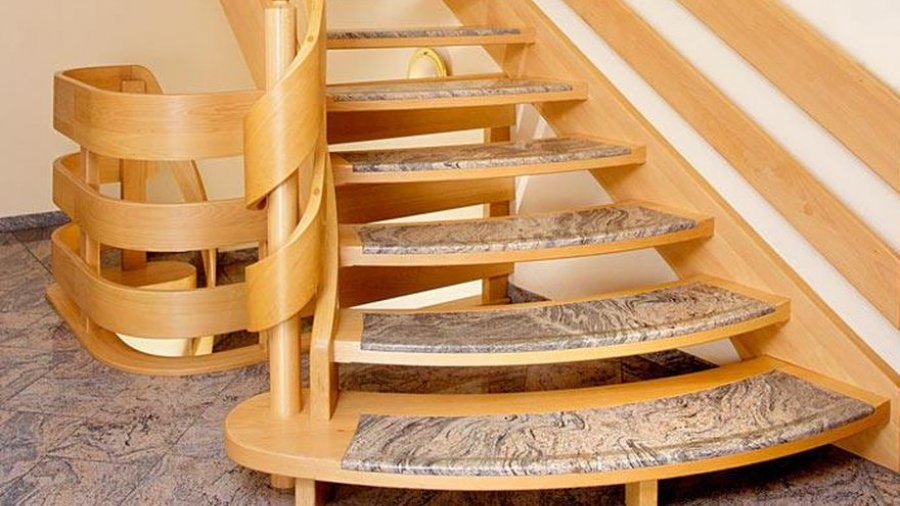
In terms of design, suspended stringer stairs are traditional stairs with treads whose stringers are made of steel strip or of natural or synthetic components.
Such stairs are often made from valuable wood species, and the treads can feature special decorative inlays of natural or artificial stone that match the floor finish.
Wood is an excellent material for stringer staircases, as it is easy to work with. It is also a warm material that brings coziness and a sense of quality to any space.
High-quality stringer stairs will adorn your interior, making it look expensive and luxurious. And to give your staircase a truly original look, you can order stairs with artistic carving.
Unlike concrete and stone stairs, wooden ones are much lighter, so the load they put on both the floor covering and the foundation as a whole is much lower.
Wood Species for Staircases
Wood is an environmentally friendly and safe material, which is why many people choose it as the raw material for stairs and cabinet furniture. Which wood species are the most popular in interior design, and why are they preferred?
- Beech and oak. The main advantages of these species are toughness, strength, durability, ease of processing and resistance to rot. Oak and beech products are also visually appealing.
- Birch. This wood has no pronounced grain pattern, and it is also reasonably priced.
- Maple. This wood is non-porous, which makes it resistant to external factors, but it is difficult to work with. It is exceptionally strong.
- Pine. An inexpensive wood, yet quite strong and easy to work with. Compared to other species it wears quickly, so it is best used for staircases that are used infrequently.
- Ash. This wood has a distinctive fiber structure that makes it even stronger and more resilient than oak. It is also easy to work with.
- Larch. An affordable, fairly strong and reliable wood.
Bent Parts of Stringer Stairs: Production Challenges
When making curved stringer stairs, the quality of every component matters. And while bent metal is a relatively easy result to achieve, wood cannot be bent without skills and special equipment. Bent wooden parts are therefore produced in three stages:
- hydrothermal treatment;
- bending;
- drying.
It is the hydrothermal treatment of the wood - which in practice means treating it with low-pressure steam in boilers - that makes it pliable. The process takes place at a temperature of 100⁰ C and a moisture level of 30 percent.
The parts are bent together with a metal strap on a hydraulic or mechanical press and then sent for drying. Drying the bent pieces takes about 8 hours, after which they are left for another 24 hours to set in their final shape. After drying, the blanks are machined on a special machine, producing the bent parts of the future staircase.
At Masiv, in addition to making high-quality custom furniture, we also manufacture exquisite wooden stairs of various types and styles.